Climate Crisis

Climate Crisis

Recurring record breaking weather events such as fires, hurricanes, and flooding have become common news. Pollinators like monarch butterflies and honey bees are in decline. Research now indicates that North America's bird population has decreased by 30% in 40 years. And NEWSFLASH! You can be part of the solution.

Take Action

+  3 BillionBIrds.ORG #BringBirdsBack
    -----------------------------------------------
+  Million Pollinator Gardens Network
    -----------------------------------------------


Showing posts with label seed. Show all posts

Friday, April 18, 2014

Plant by Habitat: Tall Grass Prairie

If you're interested in finding plants which grow naturally together, you've come to the right place. So far, we've touched on Oak Savannas and Pine Barrens; this post will cover plants you can find commercially available if you're interested in planting a prairie.


You too can grow a prairie. Here's a sample of ours including Purple Coneflower, Black Eyed Susan, and Blue Lupine

Many retailers carry prairie mixes of native seed. These mixes are often tailored to some specific growing conditions. So make sure you've thought about where you intend lay the seed down. Here are some questions to consider: Is it dry or wet? Is it clay? How much sun or shade does the site receive? The mixes often also have themes like "best for butterflies" or "good for birds." This will impact the content of the mix. Most retailers provide details about the content of each mix detailing an expected percentage of seed per plant.

One quick aside, if the site isn't getting a good amount of sun, prairie plants probably aren't the best choice, many depend on a lot of sun, after all it is the prairie.

As such, I won't be focusing on trees this time, instead this post will focus in on some good varieties of plants you may wish to purchase for your prairie.

Tall Plants: The prairie was home to many plants as tall or taller than an adult. If you are interested in these kinds of plants, that's great, but they certainly aren't for everyone. They can make a really nice background for other prairie plants.

Big Blue Stem is an attractive, tall prairie grass which can readily grow to 7 feet. We have found that birds really enjoy it in the winter including: Dark Eyed Juncos, American Tree Sparrows, and Pine Siskins. During the summer, it's not unusual for us to find American Toads on the ground at the base of the plant which can be remarkably dense. Compass Plant is another attractive native which can grow to be remarkably tall. This isn't one we've attempted to grow ourselves, but we've seen the showy yellow flowers grown locally.


Purple Coneflower is also very easy to grow and it attracts both birds and butterflies.

Less Tall Plants: Other prairie plants may grow more lowly, but be aware that how tall they grow in year one may not represent how tall they will grow in year two. Our Purple Coneflowers, Cardinal Flowers, and Little Blue Stem have gotten remarkably tall, all easily exceeding 3 feet.

Little Blue Stem is an easy to find plant which will grow as a bunch grass. It's remarkably easy to grow and the Dark Eyed Juncos seem to particularly enjoy it in the winter and early spring. Cardinal Flower has little red flag-like flowers which attract Ruby Throated Hummingbirds. It flowers a little later than some of the other wildflowers in our garden, adding some flavor to the garden a little later in the summer. This plant has actually done a little better when it's able to get some shade, our row that is in full sun seems to struggle a little more than a nearby row which gets a few more hours of shade each day.

Legumes are handy plants to include in your planting. Legumes help put nitrogen back into the soil which is beneficial for other plants.

False Indigo is a native legume which can grow into a big bush-like plant. It can be found with white or purple flowers which open earlier than some other plants you may include in your prairie such as Conefloewr or Black Eyed Susan. Blue Lupine is another native legume. Its blue flowers should appear in May ahead of the other native wildflowers. This plant is host to the Blue Karner Butterfly which is endangered. I've found that rabbits find both of these plants delicious so you may want to include some fencing to protect them as they grow.

And one more important but miscellaneous plant...

Butterfly Milkweed is a must have prairie plant for those who love the Monarch Butterfly. Its orange flowers may appear a little later than some of the other wildflowers, but it's a pollinators' delight. It doesn't seem to grow as tall as our Coneflower, but it can pretty dense, almost bush-like. Monarch Butterflies are attracted to this plant both for the flowers as adults, but it is also host to Monarch caterpillars.


Butterfly Milkweed's orange flowers up close.

There are many other plants you want to consider. The ones above only represent a small sample of the plants you want to consider. A number of other plants like: Prairie Dropseed, Blazing Star, Joe Pye Weed, Ox Eye Sunflower, and Prairie Coneflower are pretty easy to find commercially. The combination of height and color is up to you, and the choices are almost limitless. Good luck and enjoy.

Wednesday, April 2, 2014

Winged Wednesday - Five Favorite Plants for Feeding the Birds

Although bird feeders, bird baths, and bird houses are all good ways to attract birds to your yard, the most effective way to attract birds is to turn your yard into a bird sanctuary through landscaping. Plants can provide shelter for roosting or nesting, and they can provide food. Here are some great native plants for you to consider when landscaping your yard for wildlife.

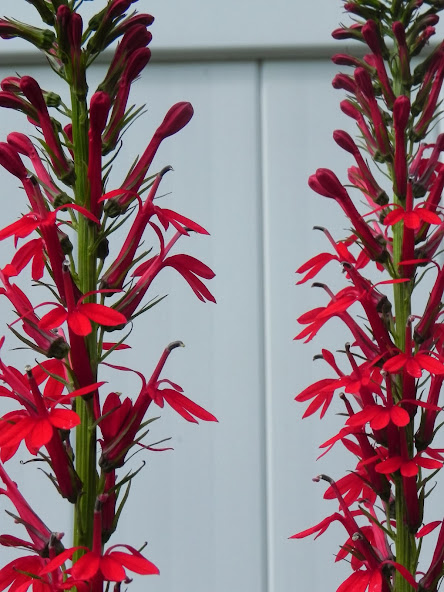
Cardinal Flower is an interesting wildflower with brilliant red flowers which display almost like flags. It's relatively easy to grow. We have two rows of it, one which is in partial shade, and the other is full sun. The row in partial shade does better than the role in full sun. Our Cardinal Flowers grew to be a little more than 3 feet tall last summer. The plant doesn't produce fruit or abundant seed, but it did have frequent visits from Ruby Throated Hummingbirds in July and August.


A couple of our Cardinal Flowers

Purple Coneflower is a familiar wildflower for many. It's an attractive pinkish flower which can grow to be fairly tall. We had some this last year which grew to be 4 feet tall. Our Coneflowers grow in full sun and are planted quite thickly. During the early spring when they are mostly leafy vegetation, they are frequented by rabbits for shelter and even Mourning Doves. During the summer when the flowers have bloomed, the local House Wrens do a fair amount of insect hunting amongst them. The Coneflowers produce abundant seed and attract American Goldfinches, Dark Eyed Juncos, Pine Siskins, and American Tree Sparrows in the fall and winter after the plant has become dry and brown.


Wren catches spider in the Purple Coneflower.

Black Eyed Susan is another familiar widflower. Our Black Eyed Susans grow mixed in with our Purple Coneflowers, our neighbor refers to it as "the jungle". The Black Eyed Susans don't grow as tall as the Coneflowers, but they do spread abundant seed around. They tend attract the same group of birds during the fall and winter as the Purple Conflower.


American Goldfinch finds a wildflower snack.

Allegheny Serviceberry is a shrub which produces a white flower in the spring. Ours is planted at the center and rear of the wildflower garden. We planted it last year, and it produced some fruit. After I had seen American Robins and Northern Cardinals eat some of the berries, I decided it might be something to try. I won't try them again; the birds can keep them. In the end, it's an attractive flowering shrub which produces berries eaten by birds (even if not eaten by humans); we're so happy with our one that we've decided to plant a couple more this year to replace the Coralberry bushes which were eaten by the rabbits.

Big Blue Stem is a tall native grass which grows to around 7 feet or so. It lines the back of our wildflower garden and is remarkably attractive both when green and fresh as well as later when dry and golden. Seed tassels form at the top, and each winter we enjoy watching the birds land on the stalks, attempting to attain the seed they seek. The bottom of Big Blue Stem is thick and full and provides some winter cover as well. We've seen American Goldfinches, Pine Siskins, American Tree Sparrows, and Dark Eyed Juncos in the Big Blue Stem during the winter.


American Tree Sparrow enjoys the Big Blue Stem.

One key is planting a good variety of plants. Having a diverse set of plants will help provide food at different times of the year for different kinds of birds. We've also tried to plant in bunches, the Hummingbirds for example will have an easier time finding a cluster of a dozen or more Cardinal Flowers than if you just plant a couple. In the end, these plants are all attractive and showy while having the added effect of attracting wildlife; what more can you ask for?

Wednesday, February 29, 2012

Winged Wednesday - Spotlight on Safflower Seed

There are a good number of choices out there when it comes to bird seed. Over the next few Wednesdays, I'll cover some of the seed options, the pro's and con's of, what birds they attract, and what feeders I'd recommend using with them. This week's featured seed is Safflower.

Safflower is a distaff thistle which hails from the Mediterranean, particularly northern Africa. Its seeds are small, white, and hard like rocks. It's not typically found in your generic wild bird seed mixes, but can be found by itself or in specialty mixes.


Safflower's biggest pro is that feeder pests are generally not interested in it. House Sparrows, Starlings, and Squirrels will generally not eat Safflower seeds.

The biggest problem with Safflower seed is that it can make a really big mess. Assuming the birds are eating all of the seeds, the hulls or outer casing of the seed will be discarded on the ground. The pile builds up quick and isn't easy to rake up. It's also been my experience that certain birds, particularly House Finches, will discard a good amount of whole seeds. These seeds may also germinate.


Safflower seed is pretty good for attracting birds. We've found that if you have Safflower seed the arrival of House Finches and Morning Doves is guaranteed. We have also found that Cardinals, Purple Finches, Pine Siskins, Dark Eyed Juncos, and Black Capped Chickadees will dine on this seed.


Initially we had this seed in a hopper feeder which had little to no tray. The volume of seed being tossed to the ground was enormous. We quickly learned that this will not work for Safflower seeds. Hopper feeders are fine so long as they have a good-sized tray. We are also now using a tray feeder which helped prevent a lot of waste. The sides of the tray feed have made it more difficult for the birds to simply discard seed. I'd highly recommend trying to use something like a tray feeder or a hopper feeder that has some edging to help prevent messes under your feeders.

Monday, January 30, 2012

Winter and Your Plants

From what I've seen on Facebook and at the garden centers, folks are itching to get back out into their yards and do some gardening. However for those of us in the Upper Midwest, winter just finally set in. There's been cold wind and snow to shovel, so it's hardly the right time to be out in the yard tending our flowers.

So if we aren't tending to our plants, what's happening to them out there in the cold? What good is winter anyway?

Vernalization is the process which enables our annuals to flower after prolonged periods of cold temperatures. In other words, some of our plants would not be able to flower without the winter. Perennials and some trees also need a prolonged period of cold to break dormancy and enable flowering. wiki

Stratification and Scarification is the process which enables certain kinds of seed to germinate. The cold temperatures can scarify seeds because of how water/moisture behaves when the temperature changes. The expanding and contracting of the moisture can scarify the outer shell of the seeds helping them to germinate. For other plants the cold weather is more like a trigger. The seeds "know" that after X number of cold weeks, followed by warmer temperatures that it's time to come out. We can accomplish this by stratifying our seeds in the refrigerator or by planting seed in the fall.

Snow is also important to plants in the winter. While the upper portion of many plants is dormant during the winter, roots are still active. The roots receive insulation and moisture from the snow, which help to keep the plant alive.

In other words, while we feel trapped inside, the environment is doing a good job tending to our native plants all winter long.

Sunday, January 22, 2012

Seed Preview 2012 Part 2

When last I posted about the seed available for 2012, I focused my attention on the local "box" store, Farm & Fleet. While Farm & Fleet has a surprising variety of seed available through the Livingston Seed Company, I knew I needed to make it out to a "real" garden shop.

A couple of weeks ago, we noticed that Jung Garden Center was advertising that their 2012 seeds had arrived. It was time to pay Jung a visit. Along an entire wall of the store, one can find seed packets for a huge number of plants. Over three quarters of it is vegetable or herb seed; it's a fantastic selection if you are planning to grow your own food. However, this is not our current objective.

Annual and perennial seed packets make up the remaining quarter of the wall. Most of which was annual seed for a variety of invasive plants. The perennials which were available from Jung included invasive plants: like Delphinium, Fox Glove, and Hollyhocks. Jung also had some native plants as well like: Purple Coneflower, Butterfly Milkweed, and Missouri Primrose (this plant was unique to Jung). They have their own cultivar of Lupine, Tutti Frutti.

The real bonus to shopping at Jung is that they carry seed from the Prairie Future Seed Company. It's on a rotating stand and appeared to be fairly picked over, as I only found empty rungs for plants like Cardinal Flower and Joe Pye Weed. This rotating stand had seeds for a cornucopia of native plants including: Blazing Star, Ox Eye Daisy, Goldenrod, and Compass Plant. I picked up some seed incorrectly labeled "Turk's Cap Lily". The scientific name on the package is Lilium Michiganense which means it's actually Michigan Lily, and I picked up some Wild Columbine seed.

While Jung as a seed company isn't providing a lot in the way of native perennials on their own, at least they are catering to those who are interested by selling seed from Prairie Future. If you are looking at replacing your invasive plants, it's a good stand to check-out. The common and scientific names are posted with images of each plant. Selecting some native lilies and irises to replace invasive varieties is made simple, other than needing to start from seed. I'll post about my progress with the lily seeds some time later.

Blue Flag Iris

Michigan Lily

Tuesday, January 17, 2012

UW Arboretum Native Plant Sale 2012

Just a heads up for those interested. The Friends of the UW Arboretum have announced the dates for this year's native plant sale. They have also posted the pre-order form so you can purchase shrubs and flats of wildflowers ahead of time. This is an excellent way to get a hold of native plants, some of which can be hard to find. So take a few minutes to browse the selection.

  1. When?
    • Order Pick Up is on May 10, 2012
    • Plant sale is on May 12, 2012
  2. How?
  3. More information can be found at the Arboretum's site

Here are some of the plants we're looking at purchasing:

Winterberry

Nannyberry

Cardinal Flower

Monday, January 16, 2012

2012 Seed Preview: Part 1

It's mid-way through January, which means stores are starting to stock up on the seeds for 2012. Last year, when we started our wildflower garden in the back, I purchased both seeds and plugs for a variety of native plants including: Blue Lupine, False Indigo, Black-Eyed Susan, Butterfly Milkweed, Prairie Coneflower, Purple Coneflower, and a few others. Most of my purchases last year were made at one of three locations: Farm & Fleet, Jung Garden Center, and Kopke's Greenhouse, so I figured I'd start at these stores again in 2012.

For Part 1, I'll address what's available at Farm & Fleet. Farm & Fleet isn't necessarily geared towards landscaping with native plants, but if you carefully comb through their selection you can find some good options for your garden. It's important to note that they did not appear to have their full stock of seeds out yet, as the only brand I could find was Livingston.

I successfully found some seed to supplement my current plants. In case anything I planted last year fails to come back, I figured picking up a few packs of seed would be a good idea. I found the following:

  1. Butterfly Milkweed
  2. Black-Eyed Susan
  3. False Indigo
  4. Purple Coneflower

I had already identified other plants which I wanted to add to our wildflower garden. Specifically I was planning on adding: Bee Balm, Cardinal Flower, Joe-Pye Weed and Lance-leaf Coreopsis. I was only able to find the Bee Balm and Coreopsis.

I did some digging around to see what else they had, but nothing else really caught my eye. They had a variety of different types of sunflower, many of which are not native to the Upper Midwest, some Lupines in a variety of colors (not blue), Baby's Breath, Cosmos, Foxglove, Bachelor's Button, and Blanket Flower (with Blanket Flower being one of the few natives I noticed).

I also picked up some extras while seed shopping at Farm & Fleet, which will help me get things started for the spring. I picked up some Columbine seed (We had some growing wild, so I figured I'd add some additional plants). I picked up a some soil, some biodegradable pots, and a plastic container to get my seeds started.

I left Farm & Fleet with a lot of stuff, but I hadn't spent much money. This is the reason I often return. I can't always find everything I'm looking for here, but I can usually find some of what I'm looking for and at better prices than what I'll get at a true garden shop. I recommend taking the time to browse their seed selection carefully and find the native plants for which you are looking.

Butterfly Milkweed

Purple Coneflower