Climate Crisis

Climate Crisis

Recurring record breaking weather events such as fires, hurricanes, and flooding have become common news. Pollinators like monarch butterflies and honey bees are in decline. Research now indicates that North America's bird population has decreased by 30% in 40 years. And NEWSFLASH! You can be part of the solution.

Take Action

+  3 BillionBIrds.ORG #BringBirdsBack
    -----------------------------------------------
+  Million Pollinator Gardens Network
    -----------------------------------------------


Showing posts with label fruit. Show all posts

Wednesday, April 16, 2014

Winged Wednesday - The Thrush Rush

The spring brings a wave of migrants to our yards, gardens, and parks. The time period from mid-April through June can make or break a bird count. One group of these migratory visitors who can really help boost a bird count are the Thrushes.

The Thrushes have traveled from the south in search of food and mates in the north. Some of these birds will stop and nest in the Upper Midwest, while others will continue their journeys northwards.

The most common of these visitors is the state bird of Wisconsin and Michigan, the American Robin. This Thrush thrives in backyards looking for grubs and worms. They are considered the heralds of spring, and they are the Thrush we can all pretty much count on seeing.


This Gray Catbird dug around in our compost before paying the neighbors' bushes a visit.

Eastern Bluebirds are becoming an increasingly common Thrush after their numbers had dropped off. Efforts to install birdhouses and monitor them over time have helped bring back the Bluebird. Like most Thrushes, they'll need the right situation to come bounding into your yard. In their case, shelter is the right incentive. Bluebirds will look for houses where they have the appropriate surroundings to forage for food, where there aren't too many other Bluebirds around, and they may require protection from House Sparrows and Starlings. (See an earlier post about birdhouses)


This Swainson's Thrush spent a couple of rainy evenings foraging in the bushes.

Other Thrushes may visit your lawn looking for food especially during or immediately after transit. In the early part of spring, berries may be their best dietary option. Parts of Wisconsin are still seeing snow, which means insect foraging isn't exactly an option. Plants like Staghorn Sumac, Dogwood, Hawthorn, and American Holly have fruit which may persist over the winter and provide food for these birds. We have seen Hermit Thrushes, Gray Catbirds, and Swainson's Thrushes scoping out our compost as well.


A Hermit Thrush at the edge of the compost.(Note - He may be hard to see, he's right in the center.)

As the weather improves, expect that you may see these birds in your yard if an understory of relatively dense shrubs is available, and if there are other sources of fruit such as Serviceberry, Chokeberry, or Nannyberry. Come fall, they will make their exit, and the following spring the cycle and count will start again.

Wednesday, April 2, 2014

Winged Wednesday - Five Favorite Plants for Feeding the Birds

Although bird feeders, bird baths, and bird houses are all good ways to attract birds to your yard, the most effective way to attract birds is to turn your yard into a bird sanctuary through landscaping. Plants can provide shelter for roosting or nesting, and they can provide food. Here are some great native plants for you to consider when landscaping your yard for wildlife.

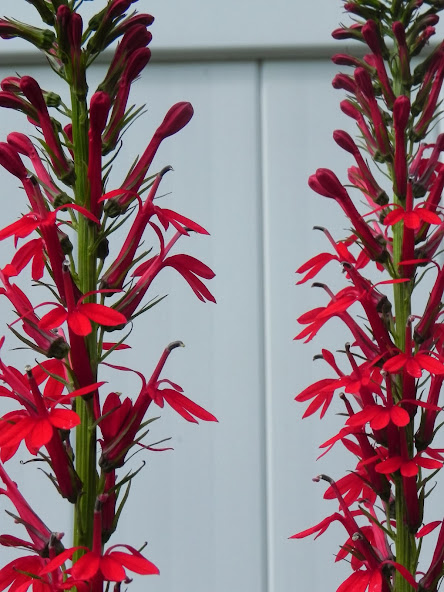
Cardinal Flower is an interesting wildflower with brilliant red flowers which display almost like flags. It's relatively easy to grow. We have two rows of it, one which is in partial shade, and the other is full sun. The row in partial shade does better than the role in full sun. Our Cardinal Flowers grew to be a little more than 3 feet tall last summer. The plant doesn't produce fruit or abundant seed, but it did have frequent visits from Ruby Throated Hummingbirds in July and August.


A couple of our Cardinal Flowers

Purple Coneflower is a familiar wildflower for many. It's an attractive pinkish flower which can grow to be fairly tall. We had some this last year which grew to be 4 feet tall. Our Coneflowers grow in full sun and are planted quite thickly. During the early spring when they are mostly leafy vegetation, they are frequented by rabbits for shelter and even Mourning Doves. During the summer when the flowers have bloomed, the local House Wrens do a fair amount of insect hunting amongst them. The Coneflowers produce abundant seed and attract American Goldfinches, Dark Eyed Juncos, Pine Siskins, and American Tree Sparrows in the fall and winter after the plant has become dry and brown.


Wren catches spider in the Purple Coneflower.

Black Eyed Susan is another familiar widflower. Our Black Eyed Susans grow mixed in with our Purple Coneflowers, our neighbor refers to it as "the jungle". The Black Eyed Susans don't grow as tall as the Coneflowers, but they do spread abundant seed around. They tend attract the same group of birds during the fall and winter as the Purple Conflower.


American Goldfinch finds a wildflower snack.

Allegheny Serviceberry is a shrub which produces a white flower in the spring. Ours is planted at the center and rear of the wildflower garden. We planted it last year, and it produced some fruit. After I had seen American Robins and Northern Cardinals eat some of the berries, I decided it might be something to try. I won't try them again; the birds can keep them. In the end, it's an attractive flowering shrub which produces berries eaten by birds (even if not eaten by humans); we're so happy with our one that we've decided to plant a couple more this year to replace the Coralberry bushes which were eaten by the rabbits.

Big Blue Stem is a tall native grass which grows to around 7 feet or so. It lines the back of our wildflower garden and is remarkably attractive both when green and fresh as well as later when dry and golden. Seed tassels form at the top, and each winter we enjoy watching the birds land on the stalks, attempting to attain the seed they seek. The bottom of Big Blue Stem is thick and full and provides some winter cover as well. We've seen American Goldfinches, Pine Siskins, American Tree Sparrows, and Dark Eyed Juncos in the Big Blue Stem during the winter.


American Tree Sparrow enjoys the Big Blue Stem.

One key is planting a good variety of plants. Having a diverse set of plants will help provide food at different times of the year for different kinds of birds. We've also tried to plant in bunches, the Hummingbirds for example will have an easier time finding a cluster of a dozen or more Cardinal Flowers than if you just plant a couple. In the end, these plants are all attractive and showy while having the added effect of attracting wildlife; what more can you ask for?

Monday, February 27, 2012

Everyone Loves Viburnums

People looking for shrubs may not be sure what plants they'll need and may not be sure what plants are native. I've been particularly impressed by the genus viburnum. The Upper Midwest is home to Highbush Cranberry, Nannyberry, Maple Leaf Viburnum, and Arrowwood Viburnum. The viburnum genus can be found throughout much of the Northern Hemisphere, and these deciduous shrubs fruit with small berries. I've added some pictures of the Highbush Cranberries we planted last year.


Highbush Cranberry(viburnum trilobum) is probably the best known of the viburnums. It can be easily confused with its European cousin and is generally available at many nurseries. You can likely find it in its typical/natural form but also comes in a compact form. It blooms with small white flowers, and in the fall, the leaves turn crimson. The shrubs berry red, if they berry at all. The plants are gendered and in order to get berries, you'll need both male and female plants.

Nannyberry(viburnum lentago) will also flower with white blooms like the Highbush Cranberry. Nannyberry is shade tolerant, and we plan to plant it in our shady corner near our Pagoda Dogwood. The fruit start light green and become blue-ish later in the year. These berries will persist through the winter and should attract birds.

Maple Leaf Viburnum(viburnum acerifolium) is another option you may want to consider. The leaves of this shrub may be broader than the previous two viburnums discussed. White flowers on this shrub give way to red berries which become blue. The green foliage turns purple in the fall. This viburnum is less shade tolerant than the Nannyberry but does require some shade to grow well. This viburnum seems to be more difficult to find commercially when compared with the Nannyberry or the Highbush Cranberry.

Arrowwood Viburnum(viburnum dentatum) has a number of available cultivars including: Blue Muffin and Autumn Jazz. This viburnum will do well in partial shade and produce blue fruit in late summer. The flowers are white like the other viburnums, and this plant is tolerant of Black Walnuts and clay soils.


Generally speaking the viburnums are pretty hardy and low maintenance. Because of their flowers and fruit, butterflies and birds may be attracted to them as well. If you don't already have some, I'd recommend planting viburnums. They are pretty great, and I'm sure you'll see why everyone loves viburnums.