Climate Crisis

Climate Crisis

Recurring record breaking weather events such as fires, hurricanes, and flooding have become common news. Pollinators like monarch butterflies and honey bees are in decline. Research now indicates that North America's bird population has decreased by 30% in 40 years. And NEWSFLASH! You can be part of the solution.

Take Action

+  3 BillionBIrds.ORG #BringBirdsBack
    -----------------------------------------------
+  Million Pollinator Gardens Network
    -----------------------------------------------


Showing posts with label biodiversity. Show all posts

Tuesday, December 13, 2016

2016 in Review

I recognize the calendar year isn't over, but both children are currently asleep, so now is as good a time as I'm going to get to retrospect on the year.

Overall, the year went by really quickly. We added new plants including junipers, red osier dogwoods, ox eyes, and asters. We also had a number of first time visitors including: Common Red Polls and Northern Flickers. In total, we've counted 44 species of birds this year.

Here's what the table looks like over time (Note: I've taken bees out of pollinators because I'm really bad at identifying species, so I'm only counting butterflies from now on.)

YearMammalsButterfliesReptiles & Amph.Birds
2016713144
2015712147
2014710140
2013710140
2012510131

We also had sandhill cranes raise a colt in the neighborhood, and they made pretty frequent visits to our yard. In addition to the cranes we had American Robins and Eastern Bluebird successfully nest in the yard.

It was another good year of biodiversity in our yard, good enough to convince me to expand one of the front flower beds again next spring to add more Little Bluestem, New England Aster, and Ox Eyes.

Crane Parenting


Red Admiral


Mr. Bluebird checking out his new house.

Thursday, January 21, 2016

Native Evergreen Shrubs and this Year's Project

After getting myself all setup on Cornell Lab's YardMap, I realized that while we'd made incredible progress in landscaping the yard and providing biodiversity, we hadn't gone as far as I'd thought. "Lawn" still makes up a large percentage of our property. This means it's time for another project. Or more precisely to circle back to a project from yesteryear and complete it as originally envisioned.

The initial mission, better layering. In particular find some shrubs.

But what kind of shrubs?

We already have lots of Serviceberry, and we have Highbush Cranberry, Pagoda Dogwood, Nannyberry, Staghorn Sumac, and Black Chokeberry.

Something new. Something different. Something with texture. Something to add interest in the winter.

I began searching. I spent a lot of time on the WI DNR's Natural Communities site.

A list of possibilities began to form: Ninebark, New Jersey Tea, Winterberry, Blueberry, Juniper, Red Osier Dogwood, Witchhazel, American Filbert...

I began searching for native evergreen shrubs. This was hard. Perhaps impractical. Perhaps evergreens don't like being shrubs.

I had found two: Juniperus Communis and Juniperis Horizontalis.

In further searching I encountered "Eastern White Cedar". I looked at the latin name, Thuja Occidentalis. How could this be? I knew Red Cedar to be Juniperus Virginiana. Of course, Red Cedar is actually a juniper tree, I read more. American Arborvitae.

"Arborvitae? Those silly hedgerow-looking evergreen trees that people plant to make privacy fences?" I thought.

I began looking at cultivars for all three: Common Juniper, Horizontal Juniper, and American Arborvitae.

I've ruled out Horizontal Juniper as I'm not looking for ground cover, but the options available for the other two are really interesting.In the end, it will probably come down to availability and selecting which ever will look best next to the Red Osier Dogwoods, I intend to plant.

More info:

  • Eastern White Cedar in WI
  • Common Juniper in WI
  • Horizontal Juniper in WI
  • Saturday, January 16, 2016

    2016 - Off to a Great Start - First Common Redpoll

    Each New Year's Eve while others excitedly waiting for a ball to drop in some distant metropolitan city, I prep a spreadsheet. The next morning begins a new year of not only bird counting but documenting each species which travels through our yard. Getting the winter well documented is crucial, as some of our visitors are drop-ins from Canada who have migrated to "warmth" of Wisconsin.

    Today, we had the first Common Redpolls to have ever visited our yard. I added them to this year's spreadsheet and then had a realization, I'd never totaled the number of species across years. I had no idea how many different species had visited the yard over the course of the last few years.


    One of the Common Redpolls who came to visit today.

    It turns out that the Common Redpoll makes number 58. This also means that my original goal (yet to be met) of having 50 species in the yard in a single year ought to be more than attainable. If last year's total of 47 is any indication (and we've already got 18 so far for 2016), 2016 could be the year. Maybe I need to think about upping the goal from 50 to 60 or 65.

    Tuesday, January 12, 2016

    2015 Year in Review

    At the start of each year, I like to reflect how the year in our little yard went. We've spent a lot time trying to turn our quarter of an acre lot into a place rich in biodiversity. This year saw the fewest amount of new plantings since we moved in. The only significant additions were another Eastern Redbud as well some additional Bee Balm and Cardinal Flower.

    Overall species diversity improved some either that or our ability to identify them has gotten better.

    Here's what it all looks like.

    YearBees and ButterfliesBirdsMammalsReptiles and Amphibians
    2012133151
    2013144071
    2014154071
    2015154771

    Noteworthy newcomers to the list included:

  • Sandhill Cranes - who skulked about the neighborhood this year
  • Eastern Wood Peewee
  • Palm Warbler
  • Here some picture highlights from last year


    Summer Tanager


    This is from the second Eastern Bluebird nest, we had 9 fledge in total over 2 nests.


    Wood Ducks came by for a short visit one spring morning too.

    2015 was a really great year, and we're hoping to do some additional planting this year to make 2016 even better.

    Wednesday, September 23, 2015

    Plant Your Corridor to Connect Remnant Habitat

    There was a time when the gusto of Manifest Destiny, the promise homesteading, and the sheer lack of forethought led a nation to near ecological ruin. Species now extinct or extirpated; whole states had to be reforested, and eventually a conservation movement brought forth national parks and forests, and other such zones which create a patchwork of wilderness.


    Remnant habit created by planting: Big and Little Blue Stem, Black Eyed Susan, Purple Coneflower, Butterfly Milkweed, Cardinal Flower, False Indigo, Lupine, Bee Balm, and Obedient Plant.

    Today one can look at a map of Wisconsin and see this patchwork of green zones which largely dominates the northern portion of our state, and we are lucky. By comparison, our neighbors in Iowa, Indiana, and Illinois have no green spaces. The wilderness of these places is replaced by pavement or turned over by plow.

    We live in a time where it has become clear that while these pockets of wilderness are beneficial, they are too sporadic and isolated to preserve the existing diversity of species over the long run. There's still some debate over the effectiveness of wildlife corridors ranging from wild success stories to dismal failure. While we consider the success and failure of modern efforts, we can take a moment to ponder these words:

    The shrinkage in the flora is due to a combination of clean-farming, woodlot grazing, and good roads. Each of these necessary changes of course requires a larger reduction in the acreage available for wild plants, but none of them requires, or benefits by, the erasure of species from whole farms, townships, or counties. There are idle spots on every farm, and every highway is bordered by an idle strip as long as it is; keep cow, plow, and mower out of these idle spots, and the full native flora, plus dozens of interesting stowaways from foreign parts, could be part of the normal environment of every citizen. - Aldo Leopold

    Wildlife corridors aren't and can't be specific zones and boundaries drawn on a map. Real corridors are created everywhere by leaving some of nature right where it was before we put in the road, plowed the field, or built our house.

    If you look at a map of your municipality you may notice features that I noticed; things which Doug Tallamy points out in the The Living Landscape. Even on a smaller scale we isolate nature preserves and parks. There's a prairie on the east side of my town and a marsh on the southwest side, but in between are homes and roads and businesses and schools.

    This is where we come in. One house, one yard providing remnant habitat is a start, one neighborhood is better. I started native planting as a project for myself. To see more birds. To test my green thumb. To do some basic green things like save on water and encourage biodiversity.


    Immature Bluebirds back from somewhere, stopping by for a visit.

    It's become a way of life and in a way an ethical code. In reading what those who came before me taught, I realized that my quarter of an acre was a small piece in a century of conservation efforts. Now when a Gray Catbird drops in, I wonder whether he is headed to or from the marsh. When the Bluebirds visit in the morning, I wonder whether they've come from the prairie this morning or from the wetlands. In my town, my yard is but a piece of a greater fabric; a piece of corridor.

    Monday, September 21, 2015

    Fall Migration - Catching Departures

    WI DNR was on WPR last week talking fall migration and trying to make the most of the end of September in southern Wisconsin. I linked out this a little awhile ago in another post. This weekend I decided to take up the call and headed out to a nearby prairie.

    A small segment of the prairie has a stand of trees, some birch, some maples, and some which I honestly can't readily identify. There are also some shrubs and a pond. The prairie itself is quite large, but I stayed in the area near the pond, probably no bigger than a block.


    Northern Flicker in a birch.

    The sheer mass of wildlife was amazing. Small birds moved through the wildflowers and grasses and then back into the shrubs, Nannyberry and Dogwood from their appearance. There were American Goldfinches, Black Capped Chickadees, Palm Warblers, Clay Colored Sparrows, Song Sparrows, Sedge Wrens, and Nashville Warblers.

    Other larger birds were more raucous, chasing each other around. They darted up into trees, swooped down to the ground; they foraged in great number. Cedar Waxwings, American Robins, Northern Flickers, and Gray Catbirds.

    Near the water, typical visitors: Canada Geese and Mallards, but also atypical visitors, 5 or more Eastern Phoebes dropping out of the trees to hawk for insects, and Eastern Bluebirds too.


    Pensive Eastern Phoebe sat still long enough for a picture.

    Through the end of the month is a good time to catch many of these smaller species, and some larger ones which stay nearer the water may be around for awhile, so you haven't missed the migration yet. Take the time to find a local park or wildlife sanctuary, grab your binoculars, and get out there. They will gone before you know it, and they won't be back until spring.

    Saturday, September 12, 2015

    An Understory Story

    Those who have had a chance to read The Living Landscape by Rick Darke and Doug Tallamy, are aware of the importance of layers in a landscape. The book breaks landscape into a essentially 4 layers: Canopy, Understory, Shrubs, and Herbaceous.

    Many backyard landscapes have a Canopy (a tree or two) and a Herbaceous layer (your flowers and grass). The current state is that a layer in between the two may be relegated to some evergreen bushes planted up against the house. It's possible to create a more diverse and interesting Understory.

    Many plants fit somewhere between the category of Shrub and Understory. Two of our neighbors have large Maples (ie Canopy) along these sides of the yard, we decided to plant an Understory of Eastern Redbud, Pagoda Dogwood, Allegheny Serviceberry, and Highbush Cranberry. Our Understory provides excellent white and pink color in the spring and in a few weeks, we expect to have vibrant fall colors.

    Most importantly, our Understory provides cover and food for wildlife. Early in the summer the Serviceberries provide fast food for our Eastern Bluebirds who found competition from American Robins. Now at the end of summer, the Highbush Cranberries are red, the Dogwood and Sumac fruit is ripe. The ripe fruit has brought back our Eastern Bluebirds, attracted a pair of Northern Cardinals, and yesterday a Brown Thrasher came to visit.

    This part of our yard is popular with the Eastern Gray Squirrels, the Black Capped Chickadees, Jays, and Thrushes.


    Swainsons Thrush visiting in the Spring


    Serviceberries in bloom with white flowers.


    Highbush Cranberry Viburnum fall color.


    Hermit Thrush paying a visit.

    Tuesday, September 1, 2015

    Backyard Apex Predators


    Take a minute to think about the wildlife which lives in your backyard. What comes to mind?

  • Eastern Cottontail Rabbits
  • Eastern Gray Squirrels (Maybe Fox or Red Squirrels)
  • Finches and Sparrows
  • Maybe some insects like ants or crickets.
  • Have you ever wondered about the food web of your yard? Or as Disney put it, "The Circle of Life"?

    To put it more plainly, who is eating who in your backyard?

    Who is at the top of the food web in your yard?

  • Neighborhood cats
  • Hawks or Owls
  • Foxes
  • Raccoons
  • Let's get one thing out of the way. Cats. Cats can be beneficial animals to have around, for example, on a farm to help control rodent populations. There is a neighborhood cat who frequently hunts in my yard, from watching him he's mostly interested in rodents and lagomorphs and other small mammals. The house cat is an introduced apex predator. This post is not going to address the environmental the complications of house cats on the ecology of a landscape; it is merely sufficient to say that cats are often our apex predators.

    Many of the other animals near the top of the food chain are birds. Coyotes, foxes, and raccoons certainly make their way into towns, and you may even have some in your yard. However to of the most common backyard predators are hawks. Red Tailed and Coopers Hawks seem to do rather well where there are people.


    Two Red Tailed Hawks hatched in our neighborhood this summer and spent a fair amount of time pursuing local rodents and stalking my bird feeders. While Red Tails are truly small mammal specialists, they are also well known opportunistic generalists. They attempted a number of occasions with more or less success to hunt birds in the yard.

    The Red Tails were never terribly successful at taking down other birds, but the Coopers Hawk with its smaller build and longer tail proved once again to be an effective Morning Dove hunter.

    When your yard is able to sustain more forms of life, the local food web becomes more apparent. Even if I had no bird feeders stocked full of seeds, the network remains intact. Our yard is now home to around 30 different species of native plant, many of which attract insects either as larva or later when nectar or fruits are available. In response, birds like House Wrens, or this evening, a Common Yellowthroat spend time amongst the plants eating the insects. If they are lucky they remain top of the food chain but of course a larger predator like a Coopers Hawk may prey on the birds.


    We don't often think of birds like Robins as being the top of the food chain but in many cases they might be. It is also important for us to keep in mind that if we are planting natives to attract butterflies and songbirds, we must also be prepared to accept the rest of the food chain. While the butterflies are beautiful they may be eaten, just as the songbirds may be silenced. We ought to consider the return of apex predators like hawks and owls a success and be confident in knowing that if our yard is healthy then its biodiversity with support all kinds of life even predatory kind.

    Sunday, March 1, 2015

    2014 Species Diversity in Review

    Each year, we count the number of different birds, mammals, reptiles & amphibians, as well as bees & butterflies which we can identify in the yard.

    We started doing this hoping to see that as we planted more native plants, we'd expect to see the yard become more diverse.

    Here's what we saw in 2014.

    YearBirdsBees & ButterfliesMammalsReptiles & Amphibians
    2014401571
    2013401471
    2012311351

    2015 has frankly gotten off to a slow start, but perhaps things will pick up in the spring.

    Wednesday, May 14, 2014

    Biodiversity Timeline


    Let's talk a little bit about biodiversity. Biodiversity is a concept related to how many different species are part of a particular community. In this particular case, how many different species are part of our yards. In nature, the amount of life a place can sustain, the more healthy it is considered. In other words, high biodiversity and an ecosystem's health are directly related. The wonderful thing about our yards, is that we as the stewards have direct control over how biodiverse our property is. If we choose to maintain a homogenous monoculture of turf grass, then we elect to keep biodiversity low. If we choose to plant a variety of flowers, grasses, shrubs, and trees, then we elect to increase the yard's biodiversity. Here's our biodiversity story so far.

    2011

    We moved into our home in April of 2011. The yard was fairly sparse, noteworthy plants included Siberian Iris, Tulips, Daffodils, and Asiatic Lilies. The yard had no trees and two ornamental shrubs. Its diversity is documented in the table below.

    Flowers 4
    Grasses 0
    Shrubs 2
    Trees 0

    I immediately began to increase the yard's diversity focusing primarily on extending the existing flower bed and adding some shrubs.

    End of Spring 2011
    Flowers 13
    Grasses 2
    Shrubs 4
    Trees 0

    In the spring of 2012, we renewed our focus on adding native plants. We added trees to the yard in 2012, and it was the first year we started keeping track of our animal diversity. We wanted to see the impact the new plants had on the ecosystem of our yard.

    2012
    Flowers 13
    Grasses 2
    Shrubs 5
    Trees 5
    2012 Animal Species
    Reptiles and Amph 1
    Bees and Butterflies 13
    Mammals 5
    Birds 31

    In 2013, we spent some time trying to dig out and eliminate the non-native plants with only some success. We also added a couple more trees and replaced some shrubs which had been chewed back by the rabbits.

    2013
    Flowers 11
    Grasses 3
    Shrubs 5
    Trees 7
    2013 Animal Species
    Reptiles and Amph 1
    Bees and Butterflies 14
    Mammals 7
    Birds 40

    This year, we've focused on the front yard, and once again we've needed to replace some shrubs. Our most recent round of plant purchases included: Prairie Dropseed, Little Blue Stem, Blazing Star, Bee Balm (Genus Monarda), Obedient Plant, and Wild Onion.

    2014
    Flowers 14
    Grasses 3
    Shrubs 5
    Trees 7
    2014 Animal Species to Date
    Reptiles and Amph 0
    Bees and Butterflies 5
    Mammals 5
    Birds 37

    From what we can tell so far, it appears that as we increase the diversity of the plant life in our yard, the diversity of the animals which come to visit increases as well. Between the flowers, butterflies, birds, and shrubs, we have interesting colors in our yard from May through October. And while the winter has less visual interest, the regular bird traffic provides more visual appeal than what the yard would have otherwise.

    Here's a list of a the current plant species which have been planted intentionally in our yard:

      Flowers:
    • Blue Lupine
    • Blazing Star
    • Obedient Plant
    • Bee Balm
    • False Indigo
    • Cardinal Flower
    • Black Eyed Susan
    • Purple Coneflower
    • Prairie Coneflower
    • Columbine
    • Butterfly Milkweed
    • Pre-existing Tulips
    • Pre-existing Daffodils
      Grasses:
    • Big Blue Stem
    • Little Blue Stem
    • Prairie Dropseed
      Shrubs:
    • Serviceberry
    • Black Chokeberry
    • Pagoda Dogwood
    • Staghorn Sumac
    • Highbush Cranberry
      Trees:
    • Bur Oak
    • Red Oak
    • Quaking Aspen
    • White Spruce
    • White Pine
    • Washington Hawthorne
    • Eastern Redbud

    Wednesday, April 9, 2014

    Winged Wednesday - Composting is for the Birds

    Having a backyard compost is useful for a number of reasons. It prevents yard waste from being landfilled. It can used to provide nutrition to the plants on the property. And it turns out that it can be a good way to attract birds.


    Our compost pile is the back corner of the lawn.

    Here's a short list of items you are likely to find in our compost:

    • Dried out grasses and wildflowers
    • Fruits and vegetables from our kitchen
    • Leaves from the previous autumn
    • Sod removed from the yard to make way for other plants.

    This small combination of organic materials does a remarkable job attracting birds for various reasons. In the spring, birds stop by the compost in search of nesting materials. They are happy to eat fruit scraps from our kitchen especially blueberry and strawberry. They can forage for leftover seed from the wildflowers and grasses.


    White Throated Sparrow forages in the compost.

    The compost also supports other life. Insects live in the compost amongst the decomposing plant matter, dirt, and debris. The White Throated and White Crowned Sparrows which came to visit us last year spent a fair amount of time scratching away at the borders of the compost. Black Capped Chickadees, Blue Jays, and the occasional Gray Catbird have been know to land in the compost and pick away a little bit as well.


    Of course the American Toads like the bugs in the compost too.

    Our yard has many features which help attract birds including: feeders, houses, trees, shrubs, and wildflowers, and our man-made brush pile contributes to the success of our yard's biodiversity just as much as the decorative features of the yard.

    Tuesday, April 8, 2014

    Plant by Habitat: Oak Savanna

    Recently I posted information about native Oaks and later realized it might be helpful to have some information not just about which plants are native vs invasive, but it may also be helpful to have some sense of which native plants actually grow together naturally. Over the next couple of weeks, I'll do some "Plant by Habitat" posts to hopefully help inform decisions about which native plants to purchase together.

    The Oak Savanna is a type of habitat which features large Oaks with room to really spread their limbs. These savannas were once found throughout the Midwest and served as the boarder between the prairies and grasslands of the Great Plains and the forests of the Eastern United States. A variety of Oak species were found in the savannas including: Black Oak, Bur Oak, Northern Red Oak, and White Oak. These trees can be found commercially available, and if you are interested in planting your own Oak Savanna, an Oak is a good place to start.

    That said other trees and plants could be found in the savannas. Shagbark Hickory and Black Cherry are also excellent savanna trees to consider. Black Cherry is particularly interesting as it is a host for a variety of caterpillars and its fruit is eaten by many birds.

    Once you've selected your trees, you are on to deciding what will go in the understory. You will need to decide exactly how wide open your savanna will be. Some savannas would have had some shrubby understory if less frequented by fire, but those more frequented by fire would have had more prairie grasses and flowers.


    Highbush Cranberry can be really attractive in the fall.

    My favorite shrubs to consider are Viburnums. American Highbush Cranberry, Nannyberry, and Mapleleaf Viburnum are interesting choices. Viburnums tend to be pretty tolerant of most growing situations, have attractive foliage in the fall, and they tend to be pretty easy to find commercially. These are really great shrubs, we have 4 Highbush Cranberries and 2 Nannyberries in our yard. Pagoda Dogwood, Hazelnut, and Staghorn Sumac are also good choices. The Sumac and the Dogwood are fairly shade tolerant, so they may not be best suited to an open savanna habitat, they do however produce fruit which can be eaten by birds. The Hazelnut will produce nuts which fall to ground and are eaten by mammals like Gray, Red, or Fox Squirrels but also by Wild Turkey and Ruffed Grouse.

    By this point, you have a tree or two selected; you've decided on a shrub or two, and now you need something to cover the ground. You are now looking for plants which do well when burned back semi-regularly. You are going to want some prairie grasses, some of the easiest species to acquire are Little Blue Stem, Big Blue Stem, and Prairie Dropseed. The flowers for an Oak Savanna can be more difficult to find but they include plants loved by butterflies such as Purple Milkweed and Common Milkweed. Shooting Star, Wild Indigo, and Wild Columbine are also reasonably easy to find as plugs or seeds.


    We put in a few indigo plants last year which were not by the rabbits.

    With these plants in place, a lawn would be replaced with a small Oak Savanna. It would be fairly biodiverse in terms of plants species and be able to support a number of bird and butterfly species. If you live in the Midwest (see map), there is a reasonable chance your yard was once in fact part of the Oak Savannas. The Oak Savannas were replaced with farmland and then the farmland with subdivisions, so why not give part of your yard back and return it to nature, after all the birds and the butterflies are the ones who have to live with it.

    Saturday, March 22, 2014

    A Year of Biodiversity in a Wisconsin Yard - 2013 Review

    We've been keeping a spreadsheet of the animals residing in our yard throughout the year. Each time we see a new species, the species is added to the spreadsheet, and the count is updated. Ideally if planting native flora is beneficial, the yard should become a haven for fauna, so as part of our grand experiment we are tracking the results.

    Below is a table showing a summary of our identified visitors since we started the tracking spreadsheet.

    YearReptile / Amph.MammalsBees / ButterfliesBirds
    2012151331
    2013171440

    Highlights from 2013


    We had a marsupial visitor early in the morning during the early Spring. This was the first time we saw a Virginia Opossum in our yard.


    This Red Tailed Hawk used our neighbor's tree to do some hunting in our yard.


    We had an Eastern Bluebird come check out the garden's bird house, only to discover the Chickadees had gotten their first.


    Of the 5 eggs, 3 successfully hatched, fledged, and left the box.


    We had Baltimore Orioles for the first time. They hung out for a couple of weeks in May.


    There was also the turkey from this post.


    The flowers also did a reasonable job attracting butterflies including this Black Swallowtail.

    2013 was a pretty good year for us with lots of interesting happenings in the yard. We're looking forward to an equally eventful 2014.

    Friday, March 9, 2012

    This Year's Plan

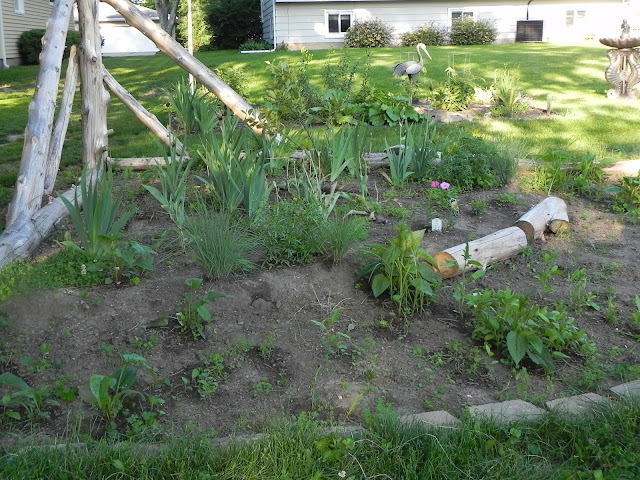
    Below you'll find a couple of photographs of our lawn from when we first purchased our home. You'll notice the stark absence of trees. From talking to the neighbors, we've been told that the yard once had Red Cedar in the front and back, but currently we have none. So the big task this year will be planting some trees.


    When I sat down with these images over the winter, I realized exactly how jealous I am of P. Allen Smith and his fancy digital whiteboard. I started with a sketch pad and noted the places in the backyard whereby planting a tree would be next to impossible. I didn't want to shade out our wildflower garden, and I'm not convinced that planting a tree in the shady part of the yard will work well either. So most of the tree planting will need to be in the front yard.

    The front yard will host four trees. The north end of the yard will have a wind-block made of Eastern White Pine, Red Cedar, and American Larch. Conifers are native to the boreal forests of North America and provide excellent shelter for the birds. On the south side of the front lawn, I plan to add a Red Oak. The acorns will attract birds and other critters, and oaks are also popular with birds that eat insects like woodpeckers and nuthatches. I'll add a couple of Nannyberry Viburnums near the oak tree as well. Lastly, I still wanted to plant something in the backyard to give the birds who visit our feeders a good place for perching, so something small like an Eastern Red Bud seems like a good choice.

    The wildflower garden did pretty well last year, but there were a number flowers we did not get a chance to plant. The bed will be extended and widened, and the following flowers will be added: Lance-Leaf Coreopsis, Cardinal Flower, and Bee Balm. There is also a small, currently unused bed, near our air conditioner in which we found a single Columbine growing last summer. I've purchase more Columbine to add to this bed this year. We're hoping the addition of Bee Balm, Columbine, and Cardinal Flower will help our yard attract more butterflies and hummingbirds.


    The shady corner is home to our compost bin which can be a bit unsightly. We had good luck with the Highbush Cranberry Viburnums and the Pagoda Dogwood which we added to this part of the yard last year, so we plan to add two more Highbush Cranberries. We will also plant some Ribes, particularly Coralberry, a type of Currant as well as a Highbush Blueberry. This corner is becoming the understory for our neighbors' oaks and maples.


    The interesting part about our landscaping so far is that coupled with the different types of bird feeders, our miniature biomes attract different types of birds. The feeders full of sunflower seeds and peanuts are nearest the shady corner. Blue Jays, Downy Woodpeckers, and Black Capped Chickadees can be found in this part of the yard. Whereas the American Goldfinches and Dark Eyed Juncos can be found nearer the wildflower garden at the nyjer feeder. With some careful planning and clever plant selection, you too can create small habitats for the wildlife in your yard.


    Friday, February 24, 2012

    Common Critters - Backyard Reptiles and Amphibians

    When we think of animals in our lawns and gardens we often think of birds and small mammals; yet they are not the only vertebrate backyard denizens. With the right conditions, your yard may attract amphibians and reptiles. The biggest key to attracting them is making sure that you aren't using chemicals. Amphibians are particularly sensitive to chemicals like pesticides and fertilizer because their skin is so porous. Here are some visitors which may indicate that you have a healthy lawn.

    The American Toad is a fairly common amphibian in the eastern half of the United States. When growing up, there was a creek and a wood lot in the back portion of our yard in rural Illinois, and we used to find many toads in our yard. I was thrilled last year, when taking weeds to the compost, that there were toads living in my yard in suburban Wisconsin. Considering amphibians are considered to be in decline and considering that Wisconsin has had reported cases of Chytrid Infection, these amphibians seem to be doing well in our neighborhood. My wife and I often encountered them while taking our beagle for an evening stroll. They tend to be about the size of an adult palm and they eat various kinds of insects. They enjoy yards and gardens with plenty of plant life and where they can find shade in the afternoon. Having some open dirt is also a good idea because they will burrow and hibernate in winter.


    Green Frogs are also an amphibian which means like our American Toad friends they are part of a phylum in decline. Frogs need more water than toads as they are far more aquatic, and with the destruction of our natural wetlands, frogs are being hit from both sides as their numbers have also dropped because of Chytrid Infection. Green Frogs are native to the eastern United States, and while they do not live in our yard (we don't have a pond), they do live in the pond at my work. My wife took the picture you can find below last summer. Green frogs aren't picky eaters and will eat insects, fish, and other amphibians. They can also be tracked by the sound they make; here's a recording from the WI DNR.


    The Common Garter Snake seems to have been more common when I was a child. I remember running into these little guys regularly on the playground at school and occasionally at home (although our yard seemed to be more prone to Eastern Fox Snakes). While I haven't seen one of these in our yard yet, I remain convinced that they must be there somewhere. These snakes will eat insects, amphibians, small rodents, fish, and birds. They are often about two feet in length and have yellow stripes along a black or brown body.

    One thing worth noting for all of the critters described above is that like many birds we wish to attract, these little guys eat insects. If you want them to hang around then avoid using insecticides on your lawn or garden; also make sure you are planting native plants which the insects will eat. While some people find these types of critters scary or disgusting, having amphibians and reptiles in your lawn is a great indicator that your yard is healthy.

    Monday, February 20, 2012

    The Good Weeds

    Wood Violets (Viola Sororia) is the state flower of Wisconsin. It often grows in shady spots of your yard like under trees. When left to grow on their own, they will spread rapidly and seed themselves. They are perennials returning each year, typically flowering in late Spring, they provide a nice splash of color before other flowers' bloom. Wood Violets may also attract butterflies before Summer flowers are available. Its roots aren't particularly deep, so if they are causing problems, they are easy to remove. Our yard is full of these little guys, but after I turned up the soil to setup our meadow garden, they started to take over so we pulled them to prevent them from shading out the seedlings.


    Dendelions (Taraxacum officinale) are a very common flower which many people have their yards treated for, but dandelions are much more than weeds. They are salad greens and can be turned into wine. Dandelions have large tap roots which is what makes them so difficult to pull. Dandelions are visited by House Finches and Goldfinches for food, and Hummingbirds may use Dandelion fluff as nesting material. Dandelions are also abundant and easily available for bees and butterflies.


    Clover (Dalea Candida - White Prairie Clover & Dalea Purpurea - Purple Prairie Clover). There are a number of species of clover that may grow in your yard but not all of these are native. White Clover and Red Clover are fairly common, but these should not be mistaken with White Prairie Clover and Purple Prairie Clover. While all of them are nitrogen fixers, which are good for your lawn, the "Prairie" varieties are native and can get rather large. Both "Prairie" species grow a large taproot that may grow 6 feet deep. Both species of clover attract a host of pollinators. Both enjoy full sun and do well in dry conditions.

    If you are interested in other weeds that aren't so good for your yard, click here.

    Friday, February 17, 2012

    Common Critters - Backyard Mammals - Part 2

    Last week, I touched on common critters which you may find in your yard or garden. In Part 1 we talked about some of the really obvious mammals who are probably munching on your plants. This week will focus on some critters who are probably out there but you don't see them very often.

    Moles are very common visitors to yards, and while we don't often see them, we do see the result of their handy-work. As they grub around under the grass looking for insects to munch, they push up the grass into molehills. We find ourselves stomping their tracks back into the ground after they've come to visit. The Midwest is home to two different species: the Star-Nosed and the Eastern Mole. While they may manage to disturb our yards; it's good to keep in mind that they are eating grubs and insects which we may not want munching on our plants later. It's worth noting that moles remain active in the winter, and while they are known for eating worms they will also eat snails, centipedes, and beetle grubs. The moles may in turn be eaten by owls, hawks, and coyotes.

    Shrews are more closely related to moles than they are to rats or mice. Shrews also eat various small critters in our yards and gardens. Some shrews in your area may include: the Prairie Shrew, Cinereus Shrew, Water Shrew, Smoky Shrew, and the Northern Short-Tailed Shrew. Shrews like the Northern Short-Tailed have a venom to help them catch prey. Shrews eat insects, small rodents, and some amphibians. Pictured below is a Short-Tailed Shrew we had last winter come and visit a tray full of safflower seed.


    Voles, unlike our previous two animals are rodents. They can be mistaken for mice and are a common food source for birds of prey such as Great Horned Owls or Red-Tailed Hawks. Voles carve out trails through your lawn; you may notice bare paths where there is no grass. These trails may have multiple burrows to help voles escape predators easily. They are veracious chewers and will eat roots, bulbs, and gnaw the bark off of trees. The Woodland Vole and the Prairie Vole are both native to the Upper Midwest and are considered to be of special concern in Wisconsin. The decline of the Prairie Vole is attributed to the loss of native prairie sod.

    Groundhogs or Woodchucks are large rodents belonging to a group known as marmots. These mammals have been made famous by Punxsutawney Phil, and growing up in rural Illinois, we had our own Groundhog who ate fallen apples from our trees. They are certainly not the most common rodent in suburbia, but we had a very close encounter with one while sitting on our deck. Groundhogs are mostly herbivorous but will eat some insects. Because of their size and their need to burrow, groundhogs can become problematic for homeowners as they may establish burrows under the deck or stoop or near your foundation or driveway.


    Monday, February 13, 2012

    Common Critters - Backyard Mammals - Part 1

    Squirrels are very common backyard critters with little fear of humans. They are attracted to our yards by bird feeders, compost piles, and trees, particularly oak trees. Depending on where you live in the U.S. you may see different kinds of squirrel visitors. In the Midwest we are likely to see Eastern Fox Squirrels, Eastern Gray Squirrels, and Red Squirrels. Both Northern and Southern Flying Squirrels can be found in the Midwest. Squirrels particularly enjoy eating acorns, sunflower seeds, peanuts, and cracked corn. If you have oak trees like many people do, whether they be White Oak, Pin Oak, Black Oak, or Red Oak, you will certainly end up with squirrels gathering acorns and burying them in your yard. Of course, squirrels can also get themselves into trouble by foraging in vegetable gardens and climbing bird feeders, and because they are more nimble and dexterous than rabbits keeping them out of trouble is a big ask. In the case of feeders, you may want to make sure to use baffles and be very aware of your feeder's placement. In the case of vegetable gardens, it's worth considering something like bird netting to put over your produce. More on Squirrels from UW Extension

    Chipmunks are squirrel-like rodents who spend much of their time on the ground. Eastern Chipmunks and Least Chipmunks are common in the Midwest and can be seen feeding under bird feeders gathering any seeds dropped by our feathered friends. Because they burrow, some people find them to be a nuisance. We've often been entertained by their high energy antics, we've even witnessed them scamper up the bird feeder pole and devour some safflower seeds. Chipmunks will also try to compete with squirrels for morsels at bird feeders but will find themselves overpowered by their larger cousins. Chipmunks are capable climbers and will also eat berries from shrubs and small trees.

    Ground Squirrels are very similar to chipmunks and can often be seen along the roadside next to farmers' fields. You may see them dart across the road, they usually appear longer and thinner than chipmunks and don't have the solid white stripes which are characteristic of chipmunks. The 13-Lined Ground Squirrel and the Franklin's Ground Squirrel both call Wisconsin home. We've had the 13-Lined Ground Squirrel visit our bird feeders and have witnessed short skirmishes between them and chipmunks competing over seeds. The Franklin's Ground Squirrel lived in the tallgrass prairie but as much of its habitat has been destroyed; it's now a species of Special Concern. If you've decided that the burrowing chipmunks and ground squirrels are a problem, before setting traps make sure you've correctly identified the species; also consider consulting with your local DNR or animal control.

    Cottontail Rabbits are happy to make your lawn or garden their home. They enjoy eating grass, most flowers, vegetables, berries, clover, pretty much anything. They even chewed branches off of my Red Chokeberry and my Serviceberry shrubs. Fencing or raised garden beds can be an effective means to be prevent rabbits from eating what you've planted. We struggled for much of last Spring and Summer with the rabbits eating the Purple Coneflowers, Blue Lupines, and False Indigo. Eventually we put up plastic fencing around some of the plants, and this year we plan to fence off the whole wildflower garden until the plants have a chance to grow. We also purchased a beagle midway through the Summer, and we think she'll be an effective rabbit deterrent as well.